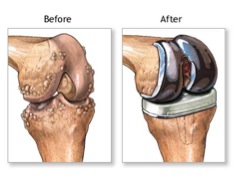
Knee replacement
is a surgical procedure to rectify serious knee damage by removing
damaged cartilage and bone in the knee joint. Then, human made
artificial bones or joints are replaced. Knee replacement can relieve
pain and allow you to be more active.
Knee replacement surgery can be performed as a total or a
partial knee replacement. In
general, the surgery consists of replacing the diseased or damaged
joint surfaces of the knee with metal and plastic components shaped to
allow continued motion of the knee. Knee replacement surgery is most
commonly performed in people with advanced osteroarthritis. It should be
considered when conservative treatments have been exhausted. Total knee
replacement is also an option to correct significant knee joint or bone
trauma in young patients. Total knee replacement can be performed to
correct serious valgus.
Knee replacements are usually performed on people suffering from painful
arthritic conditions of the knee severe enough to limit one's normal
day to day activities. Most people who have artificial knees are over
age 55, but the procedure is also offered to younger people with knee
degeneration if their quality of life is severely affected.
Knee replacement can be of different types. They are :
Partial knee replacement
Traditionally, patients have undergone
total knee replacement
for serious arthritis of the knee joint. But now, the system changed,
partial knee surgery or a uni -compartmental knee arthroplasty, is a
surgery that may be considered for
treatment of osteoarthritis
of the knee joint. The advantage is that, here a small cut is made and
recovery period is too fast, whereas total knee replacement, all
cartilage is removed from the knee joint through a big incision.
Rotating knee replacement
The
rotating knee replacement install not only swing back and forth, but
the knee can also rotate inwards and outwards. Because a normal knee
joint rotates a small amount, the rotating knee replacements are
projected to more closely imitate normal knee motion. This is one of the
replacement techniques which will ensure both reliability and
durability.
Gender specific knee replacement
Gender
specific knee replacement entitles a special technique of knee
replacement that implants are designed in a similar way, except that the
"average" is different for a man's bone and a woman's bone. The idea
behind doing this is that by better imitating the normal anatomy, the
joint replacement implants may allow for better function, as well as
improved durability.
Custom knee replacement
This
is another type, similar to other form of replacement procedure, within
a MRI is taken prior to the surgery and custom cutting guides are then
made for the patient. This helps the surgeon to remove and replace the
exact bone.
Post-operative care
During
your stay in hospital, a physiotherapist will teach you exercises to
help strengthen your knee. You can usually begin these the day after
your operation. It is very important that you follow the
physiotherapist's advice to avoid complications or dislocation of your
new joint. You will usually be in hospital for 6 to 10 days. Patients
who have had a half knee replacement usually have a shorter hospital
stay.You may be given some specific exercises to do. You may also be
given advice on taking short walks and carrying out normal household
activities, such as walking up and down stairs. These exercises will
help restore your movement and strengthen your new knee. Even after you
have recovered, it is best to avoid extreme movements or sports where
there is a risk of falling, such as skiing or riding a bicycle.
Knee joint replacement procedure is conducted by
Dr.Mohan Thadi at
Medical Trust hospital Kochi, who is well equipped with the latest cutting edge technologies.
For more details visit our website :
www.orthopaedic-surgery-india.com
Mail Id :
bangaloresurgeon@gmail.com